The Board Never Lies: A Regular's Guide to Pub Chalk Menus in 2026
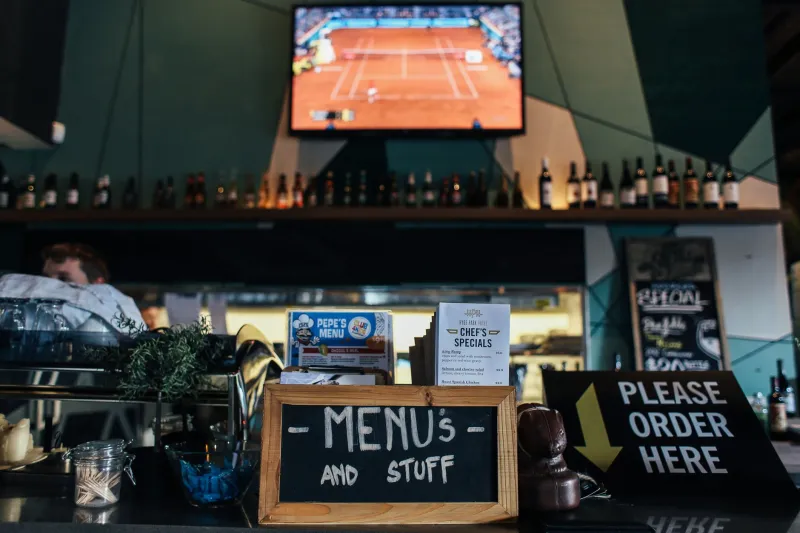
There is a moment, just inside the door, before the greeting and before the beer has settled, when you glance at the board. Not the laminated thing in the plastic wallet, not the A4 printout with the little fork logo in the corner — the actual board. The one with yesterday's ghost still faintly visible under today's chalk. That glance tells you more about the kitchen than any number of gold stickers ever will.
In 2026 the pub specials board has become the trade's quietest sign of confidence. A printed menu is a plan. A chalkboard is a decision, taken late, probably after a phone call from a fishmonger or a glance at a crate of beetroot going soft at the back of the walk-in. When it's done well, it's the most interesting reading in the pub.
Why the board is the real menu now
Kitchens have got smaller and menus have got shorter, and the space that's left has moved onto the wall. That's not a cost-cutting story, though it's often told as one. It's a cooking story. A chef who knows on Tuesday morning roughly what will be on the board on Thursday is a chef who is buying properly, cooking seasonally and, crucially, not throwing money in the bin.
The printed menu has to be reproducible. It has to work on a wet Wednesday in February when the delivery hasn't turned up, and on a sunny Saturday in July when the whole village arrives at once. The board doesn't carry that burden. It can be four things. It can be one thing. It can be a whole plaice and a bowl of peas because that's what came in and that's what's worth eating.
That's why, in 2026, the board is where you find the cooking. The printed menu pays the rent. The board is where the kitchen shows off.
How to read it like a regular
There's a knack to it, and it's mostly about looking at what isn't there.
Count the crossings-out. A board with three or four items, one of them struck through in a hurry, is a good board. It means things sell out. Things sell out because they were bought in small quantities and cooked properly. A board that never changes and never sells out is a printed menu wearing a costume.
Look at the verbs. "Roast", "grill", "braise", "fry", "cure". These are words from a kitchen with heat and time in it. "Served with", "accompanied by", "finished with" are words from a supplier's spec sheet. If the most active verb on the board is "drizzled", walk to the printed menu and pick the pie.
Read the prices. Honest boards price honestly and plainly: a number, no asterisk, no "market price" flourish. A pub that's confident about its sourcing will tell you it's £16 and let the plate do the arguing. A pub that's nervous will find ways to hedge.
Find the boring item. Every great board has one. A bowl of buttered greens. A plate of bread and good butter. A single pudding that hasn't changed since the last landlord. That item is usually the cheapest thing in the kitchen and the best value on the wall, and it tells you the kitchen isn't just chasing applause.
Check the clock. Best boards are written between ten and eleven in the morning, and the chalk is still a bit thick. If the board is spotless, symmetrical and has been photographed for three social media channels before service, you're reading marketing. Not fatal — just adjust your expectations.
The warning signs of a tired board
Every regular knows them, and every regular has ignored them at least once.
- Twelve items. Six is a board. Twelve is a menu, and a hopeful one.
- The same sauce on everything. If the aioli appears three times, the kitchen is buying it in.
- "Chef's special." Special what? Say the words. If the board won't describe the dish, nobody in the kitchen is excited about it either.
- A board that matches the printed menu. Word for word, item for item. That's not a specials board; that's a photocopier with delusions.
- A board dated last Tuesday. It happens. It shouldn't. Ask.
- No vegetarian option, no fish, no vegetable. A board that's four variations on beef is a board that isn't really shopping. It's just dividing up a delivery.
None of these is a scandal. A tired board is usually a tired week — a chef off sick, a delivery missed, a bank holiday Monday doing what bank holiday Mondays do. But two tired boards in a row is a pattern, and patterns are worth noticing.
Five boards worth planning a visit around
A short, unscientific, entirely personal list of pubs where the chalk is worth reading before you've taken your coat off.
The Sportsman, Seasalter, Kent. The board here has long been the benchmark — a daily rewriting that follows the marsh, the sea and whatever the kitchen has been curing that week. You go for the board, and the printed menu is almost an afterthought.
The Canton Arms, Stockwell, London. A big board, big flavours and no interest whatsoever in being fashionable. Portions that assume you've been working. If there's something braised on the board, order it and cancel your afternoon.
The Parkers Arms, Newton-in-Bowland, Lancashire. The board here reads like a weather report from the fells — game, roots, hedgerow things, a pudding that depends on what's in the freezer. Worth the drive and worth booking.
The Anchor & Hope, Waterloo, London. The board is written late and eaten early. If you arrive at half nine and the good thing is gone, that's the system working as intended, not a personal insult.
The Magdalen Arms, Oxford. A board that treats vegetables as a main event rather than a garnish, which in 2026 remains rarer than it should be. Order broadly, share badly.
The last word on the wall
A good specials board is a small act of honesty. It says: here is what we have, here is what we're good at this week, and here is what we'd order ourselves. It doesn't need a font, a logo or a QR code. It needs chalk, a bit of nerve and a kitchen that's actually cooking.
So next time you're in the door and the pint's settling, read the board first. If it's short, smudged and slightly out of date, you're probably in the right place. If it's immaculate and endless, order the pie, enjoy it, and keep an eye on the wall for when the real menu turns up.